

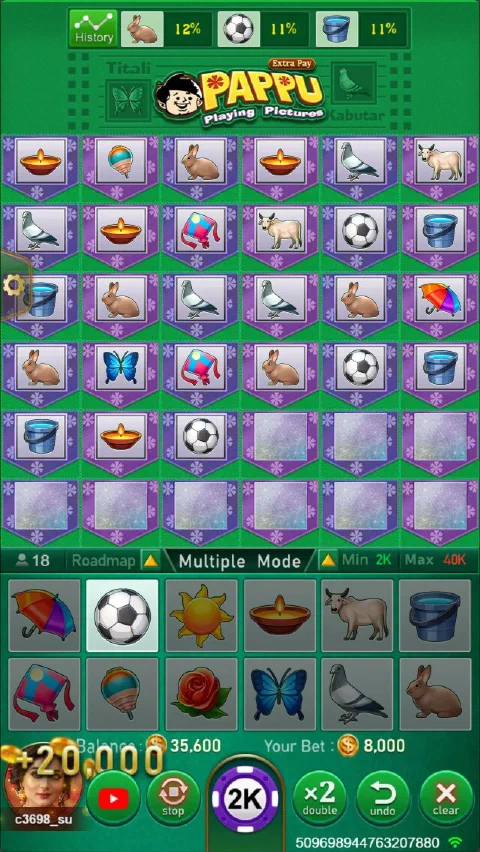
How the picture draw works#
Look for the umbrella. It appears in the upper row of choices, beside the football. Imagine putting a chip there. The chip shows which drawing you have backed. The drawing remains one of the choices on the board even if a completely different object turns up in the result. This is an easy place to start if you are used to looking for a line of matching symbols in a slot game. A lamp stake, for example, needs a lamp in the reveal. Seeing the lamp beside the sun in the choices tells you where you could put the chip.
The board has twelve pictures arranged in two rows of six. Across the top are the umbrella, football, sun, oil lamp, horned animal and bucket. Below them are the kite, spinning top, rose, butterfly, pigeon and rabbit. If you know some of these by a different name, the Hindi picture names pair familiar words with the drawings. The position helps when two people give the same animal different names.
The lower strip and the reveal grid#
First find your picture in the lower betting strip. Then look up at the reveal grid. One pattern supplies the result for the round. Compare the objects themselves, even if the drawing looks much larger in the result window. The Pappu rules step by step follow that movement from choice to reveal.
You can put stakes on more than one picture. Each addition costs the amount placed on it. If you put a unit on the rose and another on the sun, two units are committed. Only one of those distinct drawings can match the reveal. For the meaning of terms beside the pictures, such as stake and total, open the Pappu game glossary.
What to look for first#
Start with the Pappu practice board. The picture shown there is a still illustration and you can read it without opening an account. Find the butterfly beside the rose, then look for the area above where the result would appear in a running game. Picking out the two places with your eyes is enough for this first exercise. Tapping a wing in the illustration will leave the page as it was. For a first read of the poster, cover the feature marking with your thumb. Name the choice and the imagined reveal, then uncover the marking to see which tile it accompanies.
A publisher trial has a different starting point. If a trial opens to working controls, check the balance description before using them. Practise with one choice you will remember, then read the stake on that choice before the reveal. If all you see is a loading screen, the Pappu demo loading help explains how to tell where the launch stopped.
From a single choice to the result#
Suppose you choose the lamp. After the reveal, say what came up before checking any feature marking. A lamp in the result window matches your lamp stake. A sun showing above a lamp chip gives you two different pictures, even though both objects might suggest light. Identifying the picture first stops a bright Extra Pay mark elsewhere on the board from drawing your eye to the wrong place.
Extra Pay can increase a multiplier at random. Read the feature against the picture involved in that round. To review an amount, start with Pappu matching-stake payouts. If the unexpected change was in your selection before the reveal, look instead at Undo, Again and Double. Did the stake change before the reveal, or did the return change after the pictures matched?
Choose the right Pappu version#
JILI publishes this game under the name PAPPU. The board also carries the words Playing Pictures. When you find Pappu in a lobby, read the studio credit on the game entry itself. A search for the longer title can also turn up an Android product whose developer is GEBO Games. Someone giving instructions about that store entry may be describing a different product from the one open in your browser. A useful message back to a friend would be “I’m looking at the JILI listing in my browser. Which developer do you see where you are?”
Take a common example. A friend wants to show you the umbrella on the board and sends a game name without an address. Before looking for an install button, ask what appears alongside the name. A developer line and an app review identify a store listing. A JILI game entry with the two rows of pictures gives you a place to compare the board. Save the destination that answers your original question.
A JILI catalogue entry and a GEBO app listing#
JILI identifies the browser title as game 200. Use that number when it appears in the publisher’s catalogue. The Android version number identifies that app release. The two numbers describe different things, so comparing their size tells you nothing about which game is newer or which one your friend saw.
For a saved website on a phone, check the Pappu mobile options. If a larger view would help you distinguish the strip from the result window, see Pappu on a desktop browser. A question about a payment made after opening a partner account belongs with the Pappu cashier records. Keep the name of the service that issued the receipt.
Read one sample result#
Imagine an umbrella chip on the strip. The round ends with a bucket in the result window. Write down the choice and the reveal as two separate words. You backed the umbrella, so the bucket gives you a miss. Finding another bucket among the twelve choices does nothing to change that comparison. Every possible result has a place on the board, including the pictures you left empty. On paper you can swap the two drawings around. Backing the bucket when the umbrella appears gives the same sort of miss, with a different entry in History.
Change one detail for a second example. Keep the umbrella chip and imagine adding a unit to the bucket before the reveal. Now a bucket result matches the bucket stake, while the umbrella stake still misses. If both stakes were one unit, you committed two units to obtain that coverage. The word “match” alone cannot tell you how the whole round affected your balance.
Umbrella chosen, bucket revealed#
After the first example, you could find a bucket in the Pappu history strip. Someone seeing only that strip would know which picture appeared but would have no way to tell whether you had backed it. Keep your choices alongside the result if you want to understand a finished round later. Even a long run of buckets tells you only what came up before.
Use Pappu odds and coverage for the difference between counting the pictures you chose and assigning them a probability. A tip based on previous buckets belongs with Pappu trick claims. For a question about a different JILI table, Pappu and Sic Bo compared explains the change from pictures to dice. The Pappu player questions point you to the right record when a screen or result still looks unfamiliar.