
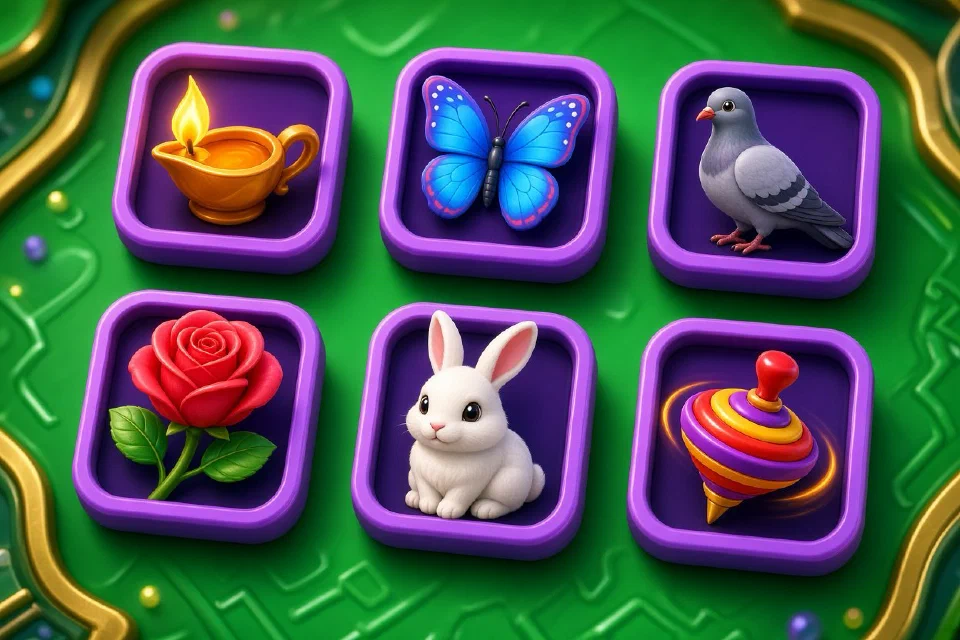
Find a picture by its silhouette#
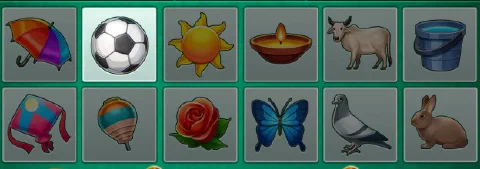
Find the umbrella at the top left. The football sits immediately to its right. At the left end of the row below there’s a kite, followed by a spinning top. Start by naming those four objects aloud. The umbrella has a canopy, the ball is round, the kite has a tail and the top comes to a point. Trace the row from an object you recognise if the next few tiles are harder to make out.
Use the table to follow one row or compare the two drawings in a column. Read down either picture column to follow one complete row from left to right. Read across a line to find which two drawings sit above and below one another. For example, if you can see the rose and want to locate the sun, the map puts them in the same column, with the sun above.
Find the canopy, lamp and kite#
Try finding the oil lamp starting from the umbrella. Move right past the football, then the sun. The lamp has a flame over a shallow bowl. A glimpse of a bright shape might have suggested either the sun or the flame, but only one has that bowl beneath it. Now drop back to the lower left. The kite’s diamond shape ends in a tail, quite different from the umbrella canopy directly above it.
If you know the object by a spoken name such as chhatri or patang, use the Hindi and English picture pairs to find its English entry. The drawings belong to JILI’s Pappu picture game, where the result of each round is one of these patterns.
| Position | Upper row | Lower row |
|---|---|---|
| First | Umbrella | Kite |
| Second | Football | Spinning top |
| Third | Sun | Rose |
| Fourth | Oil lamp | Butterfly |
| Fifth | Horned animal | Pigeon |
| Sixth | Bucket | Rabbit |
Read the result window#
Start with the one large revealed picture. If it shows a rabbit, look for the same long ears in the small selection tiles. You will find the rabbit at the far right of the lower row. If the reveal shows a football, move to the upper row and look beside the umbrella. You can practise either comparison on a still picture of a board. No stake is needed to learn which shape goes with which tile.
Notice what changes when the small object appears enlarged. The ears may be much easier to recognise, or the panels on a football may be clearer. If the reveal shows just the animal, find the same outline in the selection strip. Avoid matching by size. A large ball and a small ball are the same pattern in this exercise.
Follow a symbol between two areas#
For a paper round, put a pencil mark beside the football in your own copy of the map. Imagine the reveal shows a rabbit. Follow the rabbit from the window back to its tile, then compare that tile with your pencil mark. You have identified the revealed picture correctly, even though it differs from the picture marked on your paper. Change the imaginary reveal to a football and the two point to the same object.
Keep the result window separate from the strip of earlier pictures. You may recognise the rabbit in both places, but the history entry belongs to a completed result. To review an earlier sequence, read the picture history. If you want to check what happened to a particular choice, use the Pappu result record with the selection you made in that round.
Use shape before colour#
On a phone, first try to describe the edge of the drawing without naming a colour. A curved cover suggests the umbrella. The outline of the bucket describes a container. A rose has a flower head, while the lamp has a shallow bowl beneath its flame. Colour can help you find your way back to a tile you have already identified, but an outline gives another reader something they can recognise on their own screen.
Some objects share an outline for part of their length. The kite and the spinning top both narrow as you look down the picture. Follow the shape a little further. The kite carries a tail beyond its diamond. The top runs down to a point. If you already know which one you are looking at, use the other as a landmark. They stand side by side at the beginning of the bottom row.
Read outlines at phone size#
Try an identification test using one half of the strip. Cover the lower row and find the two upper-row drawings you might describe as round. The football has the outline of a ball. The sun has rays around its centre. Now cover the upper row and find the two lower pictures with wings. Look for the symmetrical spread of the butterfly and then for the head and beak on the pigeon.
If a cropped or blurred image still leaves you guessing, compare it with the larger illustration before attaching a name. When describing a screenshot to someone else, say which part you can see clearly. “A pointed shape beside the kite” is a more useful enquiry than insisting that a dark patch on a tiny screen is a particular picture.
Check two neighbouring pictures#
Read the middle of the lower row as a short sequence. The rose comes after the spinning top. Next comes the butterfly, followed by the pigeon, with the rabbit at the right end. If someone asks you to find the butterfly, tell them to start with the rose and move one place towards the rabbit. They can double-check by looking for a bird immediately beyond the butterfly.
The rose, butterfly and pigeon are especially useful when you are describing a crop. A cutout might omit the two ends of the strip, which makes “fourth from the left” hard to follow. If the flower and bird are still visible, the wings between them identify the butterfly. Alternatively, if the rabbit is visible next to a bird, you can work back from the right and identify the pigeon before naming the next drawing.
Rose, butterfly and pigeon in sequence#
Now try the same method on the upper row. You are looking for the horned animal. One reader calls it a goat and another calls it a cow. Check the object between the oil lamp and the bucket. Both readers can point to it without needing the same name for its species. A note that says “upper row, beside the bucket” will bring them back to the correct part of the board.
First ask which part of the screenshot the other person is looking at. Ask one to describe the big revealed object and the other to find its neighbours on the selection strip. For the names of those screen areas, see board terms explained. If the example you’re looking at shows three dice, compare the Pappu reveal with Sic Bo dice before trying to use this map.