
Identify the result in each game#
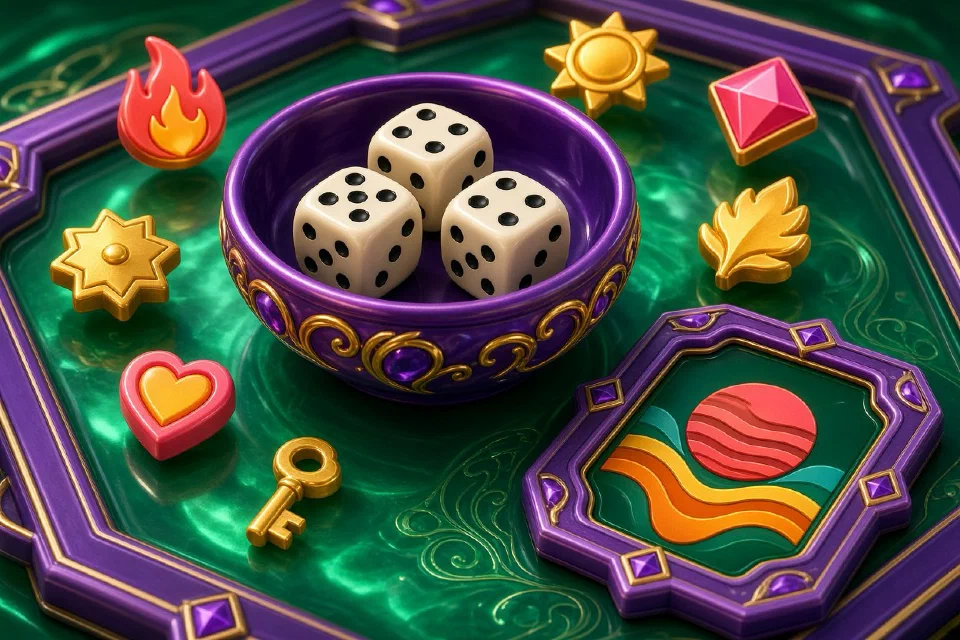
Imagine two stills from games in JILI’s catalogue. One shows a kite above a strip of small pictures. Another shows three dice. If you were asked to describe the first result aloud, a single word such as “kite” would do. To describe the second in full, you would read the face on each die. Saying only “a four” could leave out two pieces of the result.
In Pappu, one of twelve pictures appears. Compare it with your selection on the board. A person who picked the pigeon and saw a kite can identify the result just as easily as someone who picked the kite. Both saw the same reveal. Whether their stake matched depends on the picture each chose. The Pappu symbol map helps if you can identify an object by sight but want its name.
A single picture compared with three dice#
Sic Bo is JILI’s three-dice table game, listed as game 125. Pappu is game 200. Keep those names beside the catalogue numbers when you take notes. A number naming a game is easy to mistake for a feature or a return figure once it has been copied out of its original context. Keeping the label takes little effort and preserves what you found.
Try making a blank result card for each game. On the Pappu card leave a space for one revealed object. On the Sic Bo card leave three spaces for faces and another for the wording of the wager you want to check. This makes the practical difference between the games visible before you put in any result. Put the game name at the top of each card before you start filling the spaces. You can make the comparison entirely on paper.
Read a sample outcome#
Write “kite” on the Pappu card. If your chosen picture was the kite, the drawing and the reveal match. If it was the sun, they differ. There is no sum to calculate between these two pictures. Even a selection on several distinct pictures is compared with the same single reveal. For a closer look at the distinction between covering pictures and assigning them probabilities, see Pappu odds and coverage.
On the Sic Bo card, enter one, two and four as a sample roll. You can describe it in two useful ways. You saw a one, a two and a four on the dice. You can also add the three values and obtain seven. The first description retains all the faces. The second answers a question about their sum. Read the description of the specific wager before deciding which part of your observation matters.
One, two and four as a sample total#
Consider what you could recover if you wrote down only “seven”. Three sample dice showing one, three and three also total seven. They present a different set of faces from one, two and four. A person who only knows the sum cannot reconstruct the roll. When the question concerns a particular feature of the dice, keep the original faces beside your arithmetic so you can return to them.
For a parallel exercise, imagine keeping only the word “matched” on your Pappu card. You would remember the relationship between your selection and the reveal, but you would have lost the name of the picture. Add the original image name before you file the note. In either game, write what appeared before reducing it to the answer to one particular question.
Compare the Extra Pay label#
Both game descriptions mention Extra Pay. In Pappu, JILI describes a feature that can increase a multiplier at random. To apply that information to a round, look for the feature in the picture game’s own rules and inspect the markings on the round you’re reviewing. Start by identifying the picture that appeared and whether it matched the relevant choice. See how Extra Pay works in Pappu for the specific picture-board question.
In Sic Bo, JILI lists Extra Pay among the game’s features. That tells you what name to look for when you open the dice game’s information. Check each game’s own rules for its feature trigger and multiplier. If you see the feature in a Sic Bo screenshot, keep it with the dice and the wager it relates to. For a kite stake, use the feature marking on the Pappu board.
Separate the two games’ feature rules#
Imagine someone has sent two cropped images and labelled both of them “Extra Pay”. Find out which image came from which title before doing any arithmetic. A visible kite or pigeon places the discussion on a picture board. Three dice point you towards the Sic Bo rules. If both crops show only the feature label, ask for a wider view including the game title or the result area. Keep the number beside the game and feature it describes.
Once you’ve matched a rule to its game, include the condition beside any figure you copy. A note explaining that the rule concerned a specific selection gives you something to check later. A bare number under a shared feature name could be mistakenly applied to either title.
Return to the right rules#
When a lobby lists several JILI titles together, the studio credit is a good first clue. The full game name tells you which rules to open. For Pappu, look for Playing Pictures and the single-picture reveal. For Sic Bo, look for the three-dice table game. Keep the game information open long enough to identify the choice you are checking and the condition described in the rule. Close an unrelated table if you find yourself switching between two titles while reading one outcome.
When a video or chart mentions a payout, look for the name of the game that produced the result. Footage of a dice roll can illustrate how to read the three faces. Even accurate arithmetic from that footage supplies no payout figure for a picture match. Equally, a picture chart full of earlier pigeons and umbrellas cannot tell you how a dice wager is settled.
Identify the game before using a payout figure#
When sharing an example, give the reader what they’d need to reconstruct it. For Pappu, write the selected picture and the revealed picture. If you’re explaining basic terminology, the board terms distinguish the selection, stake and result. For Sic Bo, show all three faces and state what part of the roll the wager asks about. If the bet description is missing, you can still report the sum without labelling the wager a win.
Which result do you have in front of you: a single picture or three dice faces? To learn the artwork and compare one picture with another, return to the Pappu game board. To interpret a Sic Bo result, use its own rules with the original dice values still in view. In the example below, the Pappu column follows a kite while the Sic Bo column follows dice showing one, two and four.
| Feature | JILI Pappu | JILI Sic Bo |
|---|---|---|
| Result to read | One revealed picture | Three dice |
| Example observation | The kite matches a selected picture | Dice showing one, two and four have a total of seven |
| Extra Pay detail | Read the picture game rules | Read the dice game rules |